The Road Rage: Problems and solutions
1. Safety Education & Traffic Rules
Integrating traffic rules into the academic system creates a progressive awareness model tailored to age-appropriate risk:
[ Primary School ] ---> [ High School ] ---> [ Plus-Two / Higher Secondary ]
Basic Pedestrian & Bicycle Safety Bicycle Safety & Traffic Signs Licensure, Kinetic Energy, Legal & Parental Liability
- Primary Classes (Ages 5–10): Focus on basic pedestrian habits, sidewalk safety, crossing signals, and helmet compliance as passengers.
- High School (Ages 11–15): Focus on right-of-way rules, bicycle safety, understanding road signage, and early awareness of how speed impacts braking distance.
- Plus-Two & Colleges (Ages 16–20): Focus on legal responsibility under the Motor Vehicles Act (including parental penalties for minor driving), the physics of high-speed crashes, defensive driving, and the dangers of early-morning street racing.
2. Controlled Speed Tracks & Training Infrastructure
The lack of enclosed motorsports facilities leads untrained drivers to use public highways during low-patrol hours (2:00 AM – 4:00 AM) as impromptu proving grounds. Providing controlled environments shifts this dangerous behaviour away from public roads.
The need for Controlled Racing Infrastructure
| Public Highway Racing | Closed District Speed Track | |
|---|---|---|
| Shared with innocent commuters | Enclosed, barrier-protected circuit | |
| Emergency hazards & pedestrians | Required safety gear & marshals | |
| Unchecked speed & alcohol risk | Professional track coaching | |
| Severe public fatality risk | Risk confined to consenting riders | |
| Speed Limit | 80 km/h max (Design limit) | Unrestricted within vehicle/track limits |
| Traffic Mix | Pedestrians, scooters, heavy buses, mixed speeds | Homogeneous high-speed vehicles only |
| Safety Margins | Narrow lanes, roadside structures, utility poles | Wide run-off areas, gravel traps, soft barriers |
| Enforcement | Intermittent enforcement / Low early-morning patrols | Continuous track marshals & telematics |
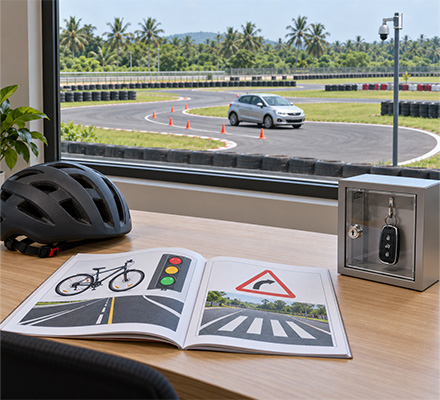
- District-Level Enclosed Tracks: Private investments or Public-Private Partnerships (PPP) can develop localized karting and high-performance track facilities equipped with run-off areas, tire barriers, and trained safety personnel.
- Skills & Handling Academies: Off-road tracks allow young motor enthusiasts to learn advanced vehicle dynamics, emergency braking, and threshold handling under professional guidance rather than through trial-and-error on public roads.
- Containment of Risk: Transporting high-speed vehicle testing off public roads isolates potential accidents to consenting participants within a controlled, medically equipped environment.
3. Legal & Parental Accountability
While infrastructure provides a safe outlet, strict enforcement of existing motor vehicle laws is necessary to prevent unauthorized key access at home:
- Parental Liability: Rigorous enforcement of Section 199A of the Motor Vehicles Act, holding vehicle owners and parents criminally responsible when a minor drives.
- Speed Limiters & Telematics: Implementing parental controls or speed-governing electronics on high-horsepower family vehicles.
- Targeted Night Patrols: Increasing automated speed cameras and mobile patrolling on major corridors between 1:00 AM and 5:00 AM