Policy Rate Decisions Amid Global Uncertainty
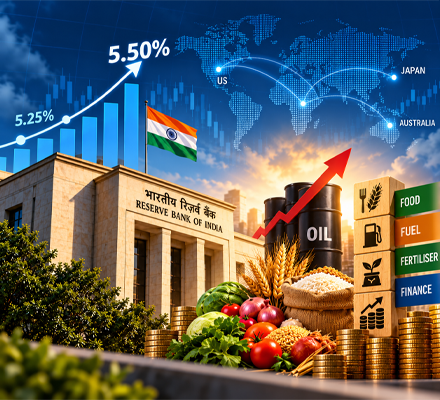
India has seen calibrated tightening after stricter hold of repo rate at 5.25 per cent for last four years. Repo rate has increased from 5.25 per cent to 5.5 percent, thereby India is joining to the global wave of rate hikes along with conditions prevailing within the country. The plausible reason is the difficult inflation outlook.
It is witnessed that the inflation rate for last three consecutive months showed an increase from the benchmark rate which was suggested by MOSPI where the combined CPI inflation is at 4.82 per cent in which rural inflation contributed 5.23 percent and urban inflation is at 4.31 per cent. There was also an upsurge in the food inflation which was at 5.95 per cent. Apart from this the headline inflation was shown at 4.2 percent. The inflationary pressures pose a question of whether it’s just internal or is it a repercussion effect to the geopolitical risks.
The identified reasons for the increase in RBI rate hike are a byproduct of higher crude oil prices, food price pressures and unfavorable weather patterns observed due to the EL-Nino phenomenon along with reasonable rigor of changes forthcoming. India showcasing a high import reliability on crude oil, hence increased prices can widen the trade deficit and rupee to depreciate. The uneasing south west monsoon leading to regional crop disruptions joined with El-Nino patterns witnessed a downfall in the agricultural crop yields lead to an increase in prices of necessities which squeezed household savings and purchasing power.
Internally, increased repo rate obviously increases the borrowing cost of the commercial banks which will reflect in the increased rate of EMIs, home loans and even more. In response to this the people borrow and spend less resulting in decreased money supply in the economy, thereby decrease in the consumption and investment and consequently the aggregate demand. In the scenario of public finance, it impacts the market borrowing cost. State government should follow the SDL spreads from the yield curve of union government and prepare rolling estimates of cash flows thereby perform stress testing on new borrowings and refinancing.
Repo rate hike is not just unique to India. Australia, Japan has shown this move in response to global inflation risks. The 4F crisis namely the food, fuel fertilizer and finance cited by the external affairs minister S. Jaishankar also showed the time is alarming and aftermath awaits when the whole world is preparing for a global reset.